

Most commercial fire risks do not begin with obvious visible danger.
They start with operational issues that slowly become “normal.”
A dryer cycle taking longer than usual. Laundry rooms feel hotter than before. Maintenance teams repeatedly clearing
lint around vents. Tenant complaints gradually increase.
At first, none of it feels urgent.
That’s what makes dryer vent problems so dangerous on commercial properties.
Across apartment complexes, student housing, healthcare facilities, hotels, and multi-unit residential buildings, dryer vent
systems quietly become one of the most overlooked safety risks — not because maintenance is ignored, but because
the warning signs usually develop slowly enough to seem manageable.
Until airflow becomes critically restricted.
Until systems begin overheating.
Until a preventable maintenance issue turns into an emergency.
The difference between routine maintenance and fire exposure is usually timing.
Why Commercial Dryer Vent Systems Become Riskier Over Time
Commercial laundry systems operate under constant demand. Every drying cycle pushes heat, moisture, and lint through
the vent system.
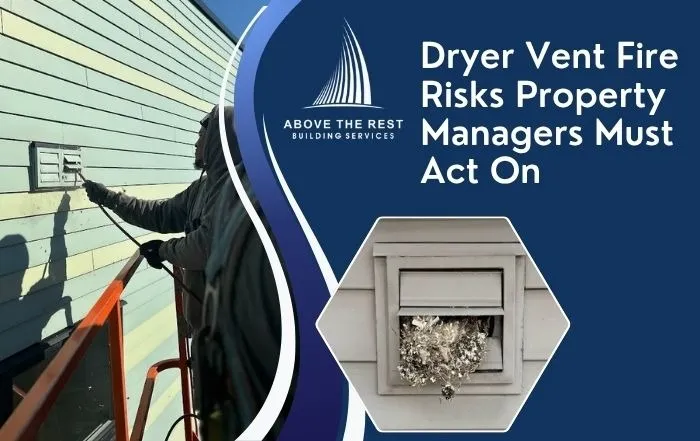
Over time, lint begins accumulating inside exhaust pathways, duct transitions, vent corners, and termination points.
The dryer still works.
Which is exactly why the issue gets delayed.
But internally, airflow starts slowing down. And once airflow becomes restricted, heat remains trapped longer, equipment
works harder, and lint becomes increasingly combustible.
The real problem isn’t the lint alone.
It’s the combination of trapped heat, restricted airflow, and continuous system usage.
That’s where dryer vent fire risks begin escalating.
The Early Warning Signs Usually Look Operational
Most commercial dryer vent issues don’t initially appear as “fire hazards.”
They show up as operational inefficiencies.
Property managers usually notice:
- Longer drying cycles
- Recurring overheating complaints
- Excessive heat in laundry rooms
- Rising utility costs
- Frequent equipment service calls
- Visible lint around vents
- Inconsistent dryer performance
Individually, these signs may seem manageable.
Together, they usually indicate the vent system is already struggling internally.
And at that point, the problem is no longer just maintenance — it becomes a building safety concern.
Why Dryer Vent Fire Risks Escalate Faster Than Expected
Dryer vent systems rarely stabilize on their own.
The longer lint buildup remains inside the system:
- Airflow continues decreasing
- Heat continues accumulating
- Equipment strain increases
- Fire risk becomes greater
What makes these situations dangerous is how quietly the risk develops.
There’s often no dramatic warning before overheating begins affecting the system.
That’s why many commercial properties underestimate dryer vent fire exposure until operational problems become impossible to ignore.
What Property Managers Usually Search For When Problems Escalate
Once dryer vent issues become urgent, priorities shift quickly.
Property managers are no longer asking:
“Should we clean the vents?”
They’re asking:
- How much buildup already exists inside the system?
- Is the airflow already restricted?
- Could this become a safety issue?
- How quickly can this be inspected?
- Will this disrupt tenants or operations?
At this stage, speed and clarity matter more than anything else.
The reality is — most of these situations could have been controlled much earlier through preventative inspection and maintenance.
Why Preventative Dryer Vent Maintenance Matters
Well-maintained, high-performing commercial properties rarely wait for systems to fail before taking action.
They treat dryer vent maintenance as part of long-term operational risk control.
Professional commercial dryer vent cleaning services can help:
- Reduce fire exposure
- Improve airflow efficiency
- Reduce dryer strain
- Shorten drying cycles
- Improve equipment lifespan
- Lower unnecessary energy usage
- Reduce recurring maintenance issues
More importantly, preventative maintenance helps property managers stay proactive instead of reactive.
Because once systems begin overheating consistently, the cost of delay can become far greater than the cost of prevention.
The Hidden Operational Impact Most Properties Underestimate
Dryer vent issues don’t just affect laundry performance.
Over time, they can begin affecting:
- Tenant satisfaction
- Operational efficiency
- Maintenance budgets
- Equipment reliability
- Emergency response exposure
Repeated complaints about dryer performance may seem minor at first.
But in commercial environments, recurring operational issues usually point to a larger system problem already developing behind
the scenes.
And once fire risk enters the equation, the issue becomes far more than maintenance.
It becomes liability.
Commercial Properties Most at Risk
Dryer vent fire risks can increase significantly in:
- Apartment complexes
- Student housing
- Assisted living communities
- Hotels
- Healthcare facilities
- Laundromats
- Multi-family residential buildings
Any commercial property operating shared or high-volume dryer systems should schedule regular dryer vent inspections
and cleaning.
Because the more frequently systems operate, the faster hidden buildup can accumulate.
A More Practical Approach to Dryer Vent Risk Prevention
Most dryer vent emergencies are preventable long before they become dangerous.
A structured maintenance plan typically includes:
- Scheduled dryer vent inspections
- Airflow performance testing
- Lint buildup removal
- Exhaust pathway cleaning
- Identifying restricted vent sections early
- Preventative maintenance scheduling based on property usage
This shifts dryer vent maintenance from reaction → prevention.
And that shift is where most fire risks can be reduced.
Frequently Asked Questions
How often should commercial dryer vents be cleaned?
Most commercial properties should schedule professional inspections and cleaning at least annually. High-usage facilities
may require more frequent servicing.
What are the early signs of dryer vent blockage?
Long drying times, excessive heat, humidity buildup, burning odors, lint accumulation, and repeated equipment
issues are common warning signs.
Can blocked dryer vents increase fire risk?
Absolutely. Restricted airflow combined with lint buildup can increase overheating and fire exposure.
Do dryer vent issues increase utility costs?
Yes. Dryers with restricted airflow may operate longer and consume more energy.
Who benefits from commercial dryer vent cleaning services?
Apartment complexes, hotels, healthcare facilities, student housing, laundromats, and multi-unit residential properties can
all benefit from routine dryer vent maintenance.
Why Above The Rest Building Services?
At Above The Rest Building Services, we help commercial properties across New England reduce dryer vent fire risks through
structured inspection, cleaning, and preventative maintenance solutions.
Our team supports property managers with:
- Professional dryer vent cleaning
- Airflow restriction identification
- High-access vent servicing where required
- Safety-focused execution in active environments
- Minimal operational disruption during service
Because preventing risk early is always easier than managing it after escalation.
Before a Dryer Vent Problem Becomes an Emergency
Most dryer vent fire risks are preventable.
The problem is — they rarely look urgent early enough.
If dryers are taking longer, laundry rooms feel hotter than usual, or vent systems haven’t been professionally inspected
recently, the risk may already be developing inside the system.
For property managers, early action helps protect:
- Tenants
- Operations
- Equipment
- Maintenance budgets
- Overall property safety
Because when dryer vent problems finally become visible, the exposure has usually been building for much longer than expected.
